Bing Maps Driving Directions
Bing Maps driving directions is one of the most powerful and reliable online navigation tools available today. Whether you need to find the quickest route to work, plan a cross-country road trip, or simply navigate to an unfamiliar address, Bing Maps offers a comprehensive suite of features designed to make your journey effortless. Developed by Microsoft, Bing Maps combines advanced satellite imagery, real-time traffic data, and intelligent route optimization to deliver accurate driving directions you can trust.
Unlike many navigation services that require subscriptions or account sign-ups, Bing Maps driving directions is entirely free to use. From the moment you open Bing Maps, you have access to turn-by-turn navigation, live traffic overlays, multi-stop route planning, and bird's eye aerial views — all without spending a dime. You can also compare options with mapquest. This makes it an ideal choice for everyday commuters, delivery drivers, and travelers alike.
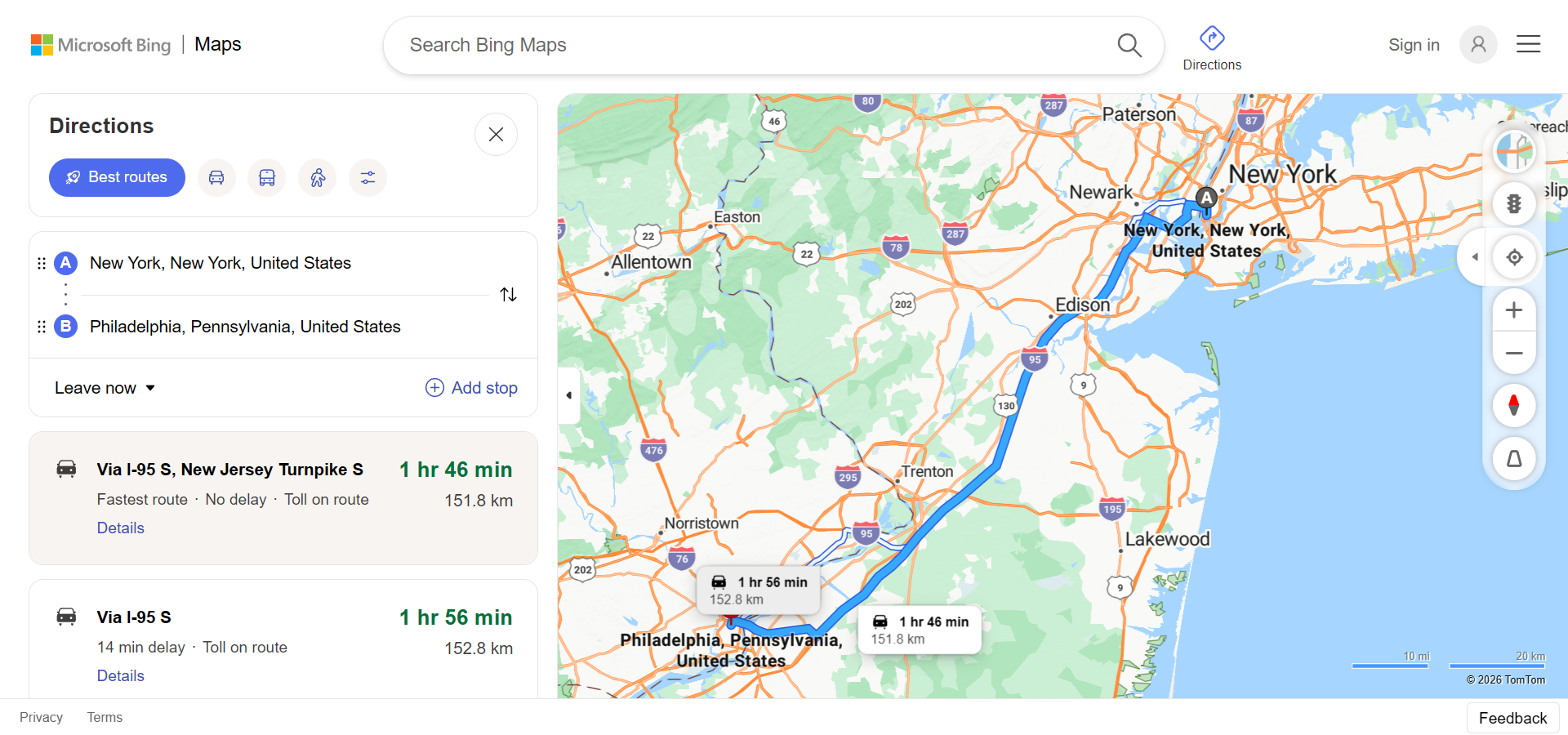
How to Get Driving Directions on Bing Maps
Getting Yahoo Maps is a straightforward process that takes just a few seconds. Whether you're using a desktop browser, a tablet, or a smartphone, the process remains intuitive and user-friendly. Here's a detailed step-by-step guide:
- Open Bing Maps — Open Bing Maps in your preferred web browser. If you have location services enabled, the map will automatically center on your current location, giving you a familiar starting point.
- Enter Your Starting Point and Destination — Click on the directions icon (the arrow symbol) to open the route planning panel. Type your starting address in the first field and your destination in the second. Bing Maps supports full street addresses, city names, landmarks, business names, and even GPS coordinates.
- Select Driving as Your Travel Mode — You'll see several travel mode options including driving (car icon), transit, walking, and cycling. Select the car icon to calculate your driving directions. Bing Maps will instantly compute the optimal route based on current traffic conditions.
- Review Your Route Options — Bing Maps typically suggests two or three alternative routes. Each route displays the estimated travel time, total distance, and current traffic conditions along the path. Routes highlighted in green indicate free-flowing traffic, while yellow and red sections warn of congestion.
- Start Navigation or Print Directions — Once you've selected your preferred route, you can begin turn-by-turn navigation on your device. Alternatively, you can print the driving directions for offline reference — a handy option when traveling through areas with unreliable cell service.
Key Features of Bing Maps Driving Directions
What sets Bing Maps apart from other navigation platforms is its rich feature set that goes well beyond simple point-to-point routing. Here are the standout features that make Bing Maps a preferred choice for millions of users. For dedicated route guidance, explore mapquest directions.
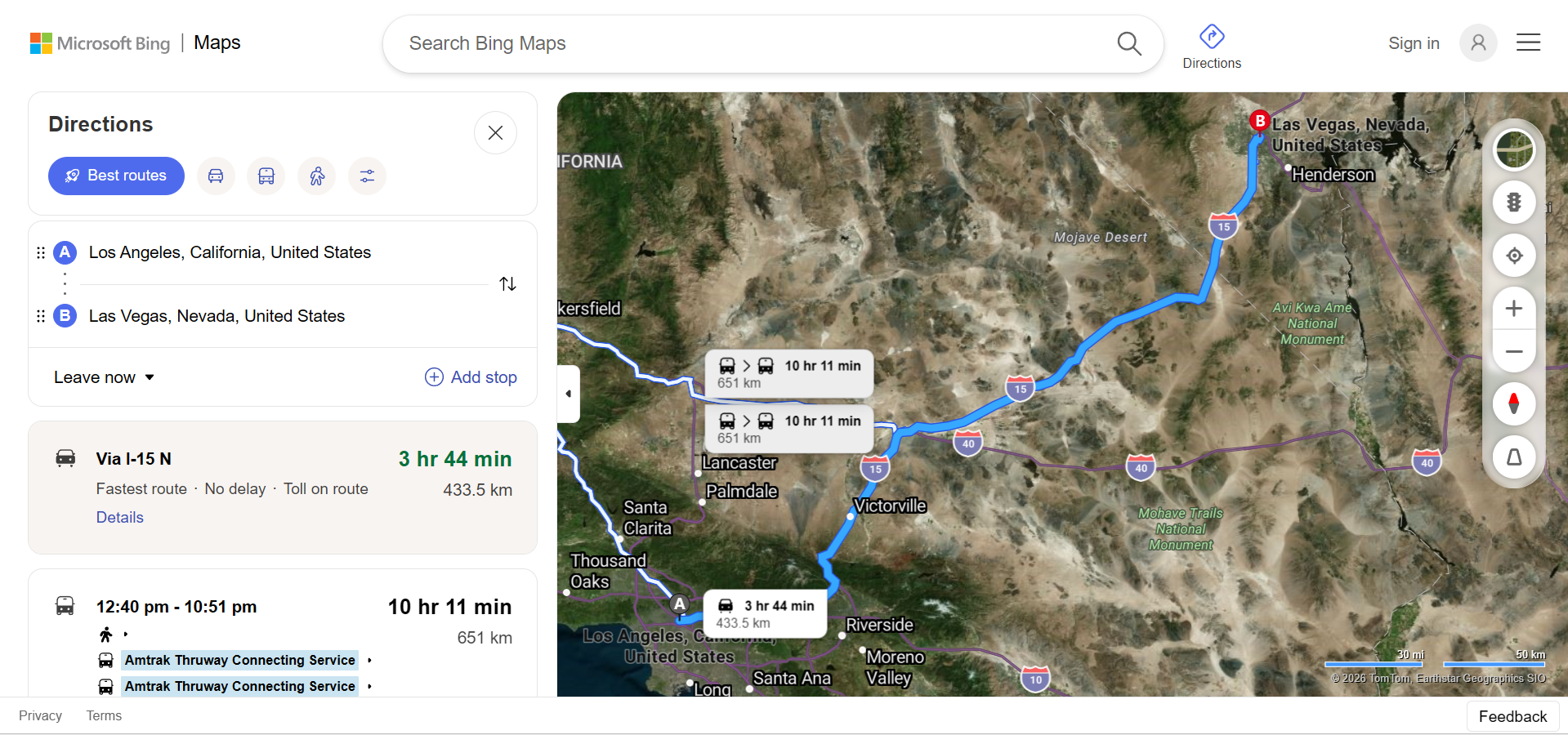
Turn-by-Turn Navigation
At the heart of the Bing Maps driving directions experience is its detailed turn-by-turn navigation system. Once you've entered your route, Bing Maps provides sequential instructions for every turn, lane change, highway exit, and roundabout along the way. Each instruction includes the street name, the distance until the next maneuver, and the estimated time to reach it. This level of detail ensures you never miss a turn, even in unfamiliar territory.
Real-Time Traffic Updates
One of the most valuable features of Bing Maps is its live traffic integration. The traffic layer overlays real-time data onto your route, using a color-coded system: green for clear roads, yellow for moderate slowdowns, and red for heavy congestion or standstill traffic. Beyond simple color coding, Bing Maps also displays incident markers for accidents, construction zones, road closures, and special events that may affect your drive. When delays are detected, Bing Maps can automatically suggest an alternative route to help you save time.
Multiple Route Options
Rather than locking you into a single path, Bing Maps driving directions presents multiple route alternatives side by side. You can compare them by travel time, distance, and traffic conditions. Some routes may be shorter in distance but slower due to traffic, while others may take a longer path on highways for a faster arrival. This flexibility allows you to choose the route that best fits your priorities — whether that's speed, simplicity, or scenic value.
Multi-Stop Route Planning
Planning a trip with several destinations? Bing Maps supports multi-stop route planning, letting you add as many waypoints as you need. Simply click "Add a stop" after entering your initial origin and destination, then add your additional stops in order. You can rearrange stop order by dragging, and Bing Maps will recalculate the most efficient driving route through all your waypoints. This feature is perfect for road trips, delivery routes, errand runs, and sales territory planning.
Bird's Eye View and Streetside Imagery
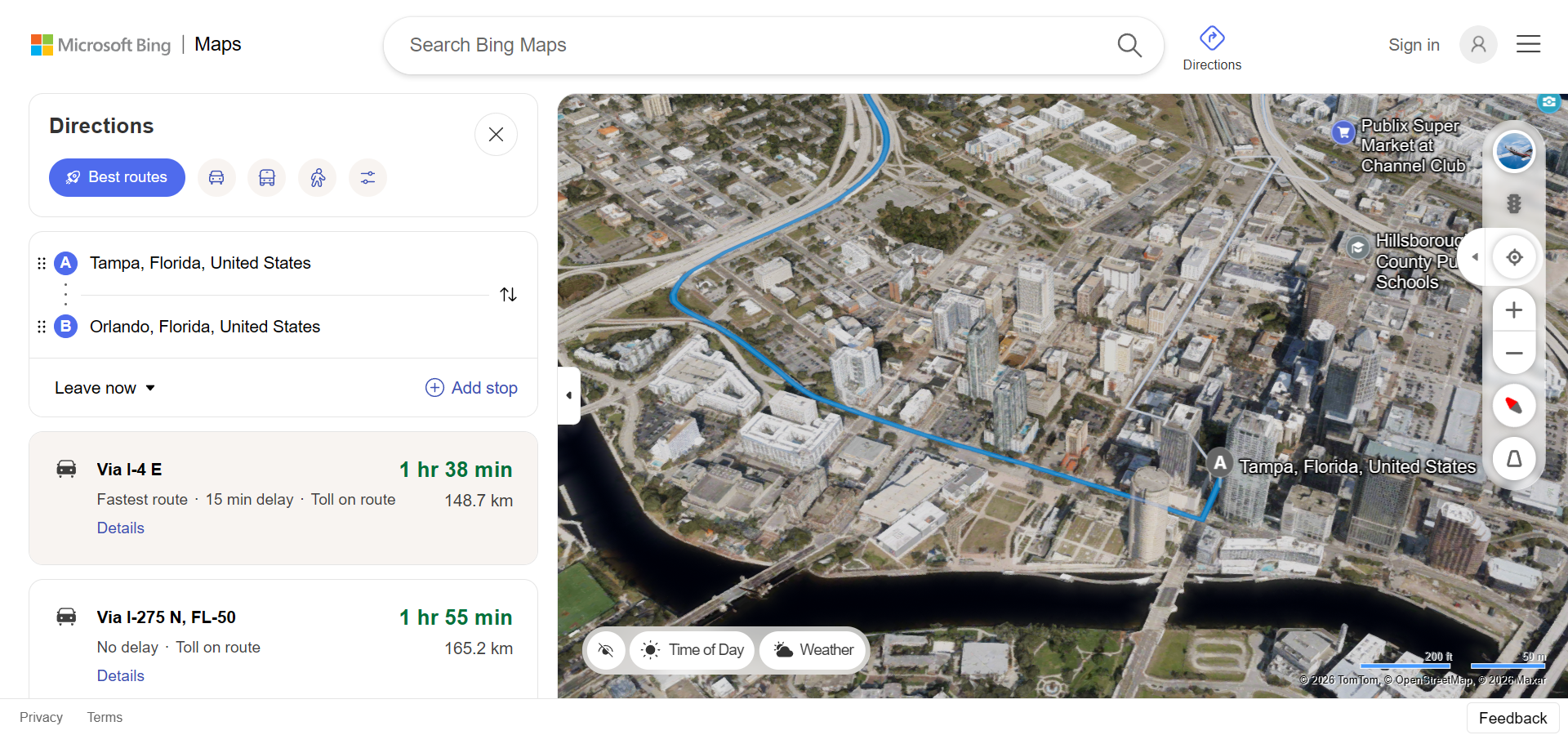
Bing Maps offers high-resolution aerial imagery captured at an oblique angle, known as Bird's Eye view. This unique perspective gives you a near-3D look at buildings, intersections, and terrain along your route. Combined with Streetside imagery — Microsoft's equivalent of street-level photography — you can preview exactly what your destination looks like before you arrive. This is particularly helpful for finding parking entrances, identifying building facades, or getting oriented in complex urban areas.
Cross-Platform Accessibility
Bing Maps driving directions works seamlessly across all devices and platforms. Whether you plan your route on a desktop computer at home and then pick it up on your phone in the car, or start navigation directly on a tablet, the experience is consistent and responsive. Bing Maps is accessible through any modern web browser without requiring a dedicated app, though dedicated apps exist for Windows devices with enhanced integration.
Why Use Bing Maps for Driving Directions?
With several navigation platforms available, you might wonder what makes Bing Maps driving directions worth choosing. Here are the compelling reasons millions of users rely on Bing Maps every day:
Accuracy You Can Trust — Microsoft invests heavily in keeping its mapping data current and precise. Bing Maps uses a combination of satellite imagery, aerial photography, GPS data from millions of devices, and partnerships with local authorities to ensure that road networks, speed limits, and points of interest are always up to date. This translates to driving directions you can rely on, with accurate distance calculations and realistic estimated arrival times.
Completely Free, No Strings Attached — Unlike many navigation services that require subscriptions or account sign-ups, Bing Maps driving directions is entirely free to use. From the moment you open Bing Maps, you have access to turn-by-turn navigation, live traffic overlays, multi-stop route planning, and bird's eye aerial views — all without spending a dime. This makes it an ideal choice for everyday commuters, delivery drivers, and travelers alike.
Deep Windows Ecosystem Integration — For users within the Microsoft ecosystem, Bing Maps offers a uniquely integrated experience. It works hand-in-hand with Windows 10 and 11, Microsoft Edge, and Cortana. You can ask Cortana for driving directions by voice, and the results will display directly in Bing Maps. This seamless integration makes Bing Maps the most natural choice for Windows users.
Privacy-Focused Navigation — In an era of growing data privacy concerns, Microsoft's commitment to user privacy gives Bing Maps an important edge. Your search history, favorite locations, and route data are protected under Microsoft's privacy policies, and you can use Bing Maps without logging in if you prefer to keep your navigation fully anonymous.
Bing Maps Driving Directions vs. Google Maps
Both Bing Maps and Google Maps are excellent navigation tools, but they differ in several key areas. Bing Maps excels with its Bird's Eye aerial imagery, which provides a much more detailed angled view than Google's standard satellite imagery. For users who want to preview their destination's surroundings in rich detail, Bing Maps is the superior choice.
Google Maps may have broader street-level coverage globally, but Bing Maps offers superior integration with desktop Windows environments and Microsoft's productivity suite. If you're already using Outlook for calendar events with addresses, Edge as your browser, or Windows as your operating system, Bing Maps driving directions integrates more naturally into your workflow.
In terms of route accuracy and traffic data, both platforms perform similarly in major metropolitan areas. However, Bing Maps tends to offer a less cluttered interface with fewer ads and pop-ups, providing a cleaner, distraction-free navigation experience when you need to focus on your driving directions.
Expert Tips for Using Bing Maps Driving Directions
To get the most out of your Bing Maps experience, consider these practical tips from experienced navigators:
Check Traffic Before You Leave — Before starting any trip, spend a moment reviewing the traffic layer on Bing Maps. Real-time congestion data can reveal unexpected delays, allowing you to either adjust your departure time or choose an alternative route proactively. This simple habit can save you significant time over the course of a week, especially on regular commutes.
Use the "Arrive By" Feature — If you have a specific arrival time in mind — such as making it to an appointment or catching a flight — Bing Maps can calculate the ideal departure time based on predicted traffic patterns. This is one of the most underutilized features of Bing Maps driving directions, and it's incredibly valuable for time-sensitive travel.
Save Frequent Locations — If you regularly navigate to the same addresses — your gym, a client's office, a family member's home — save them in Bing Maps for one-click access. This eliminates the need to retype addresses every time and makes getting driving directions even faster.
Print Directions for Backup — Even in our connected era, there are areas with poor cellular reception. Printing your Bing Maps driving directions before a trip to a rural or unfamiliar area ensures you always have a reliable backup. The printed format includes detailed turn instructions, highway exit numbers, and cumulative distances.
Explore Bird's Eye View Before You Go — If you're visiting a new area, use the Bird's Eye view to get a detailed look at the surroundings beforehand. This can help you identify parking areas, building entrances, and landmarks that will make your arrival smoother and less stressful.